
What Will You Pay for Medicare in 2027? Income Brackets, Part B Premiums and Five Years of COLAs
In 2027, the standard Medicare Part B premium is $209.40 per person per month, up $6.50 from 2026. You pay the standard rate if your income was $112,000 or less on an individual return or $224,000 or less on a joint return. For most people, Part A still costs $0 a month. Social Security benefits rise 3.6% starting with January payments.
If you’re comparing next year’s Social Security check with this year’s, look at two lines on your notice. Check the benefit before deductions and the amount withheld for Medicare. They change for different reasons. Social Security announced the 2027 cost-of-living adjustment (COLA) on October 14, 2026. The Centers for Medicare & Medicaid Services (CMS) released the Medicare figures on November 17. The formal Part B notice appeared in the Federal Register on November 19, and the rates take effect January 1, 2027.
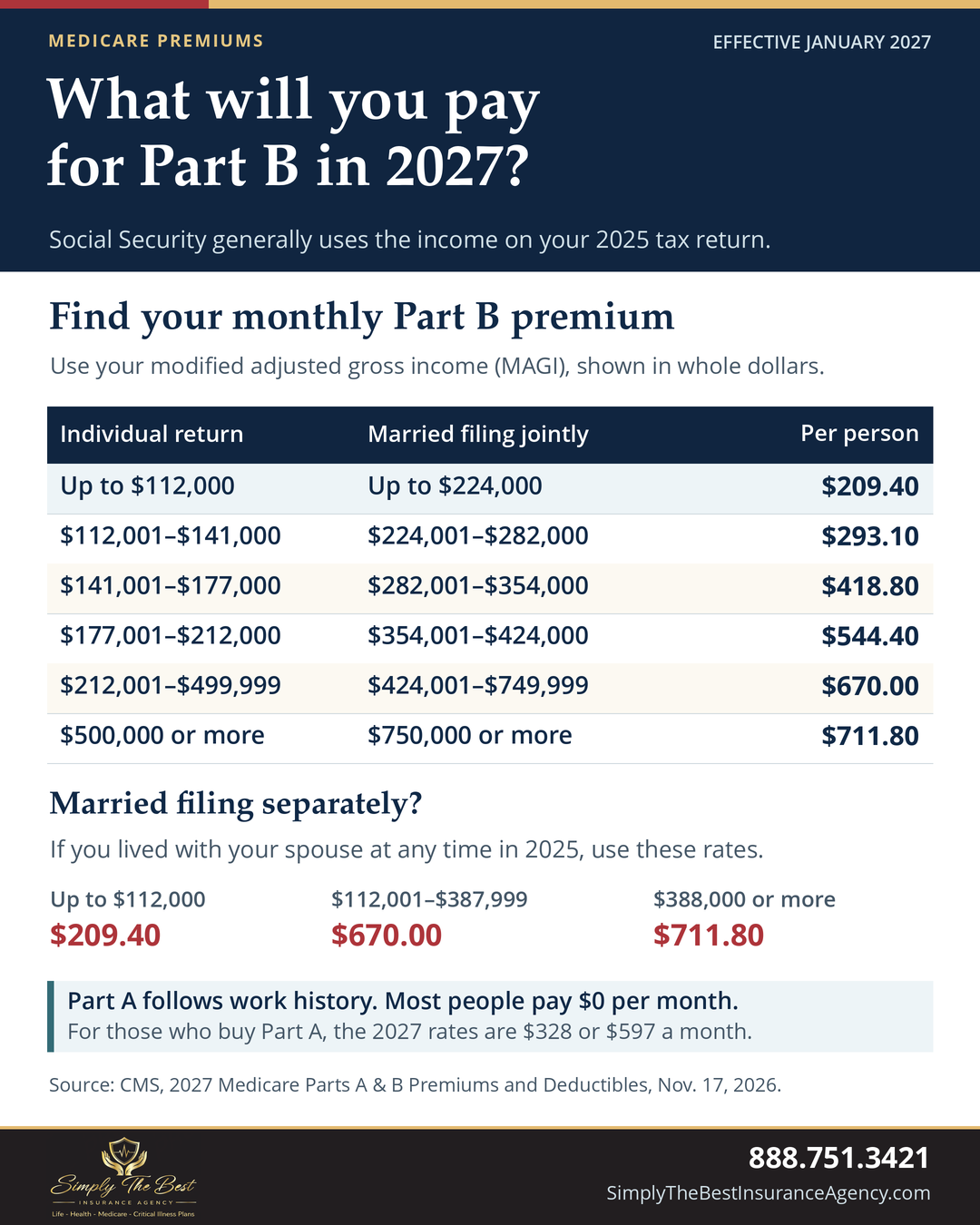
Find your 2027 Part B premium by income
Social Security generally uses your 2025 federal tax return to set your 2027 premium. For this purpose, modified adjusted gross income (MAGI) is generally your adjusted gross income plus tax-exempt interest. Once your income crosses a threshold, an income-related monthly adjustment amount (IRMAA) applies.
Use the last column to budget for one person with full Part B coverage. It already includes the surcharge. The figures assume no late-enrollment penalty or premium assistance.
| Individual return MAGI | Married filing jointly MAGI | Monthly surcharge | Total per person per month |
|---|---|---|---|
| $112,000 or less | $224,000 or less | $0.00 | $209.40 |
| Over $112,000 through $141,000 | Over $224,000 through $282,000 | $83.70 | $293.10 |
| Over $141,000 through $177,000 | Over $282,000 through $354,000 | $209.40 | $418.80 |
| Over $177,000 through $212,000 | Over $354,000 through $424,000 | $335.00 | $544.40 |
| Over $212,000 and under $500,000 | Over $424,000 and under $750,000 | $460.60 | $670.00 |
| $500,000 or more | $750,000 or more | $502.40 | $711.80 |
For a couple filing jointly with exactly $224,000 of MAGI, each spouse enrolled in Part B pays $209.40. At $224,001, each pays $293.10. If both spouses have Part B for all 12 months, that difference is $2,008.80 for the household over the year.
Married and filing separately? Your living arrangements matter
If you filed a separate return and lived with your spouse at any point in 2025, use these three bands. If you lived apart for the entire tax year, use the individual column above.
| 2025 MAGI on separate return | 2027 monthly surcharge | 2027 total per month |
|---|---|---|
| $112,000 or less | $0.00 | $209.40 |
| Over $112,000 and under $388,000 | $460.60 | $670.00 |
| $388,000 or more | $502.40 | $711.80 |
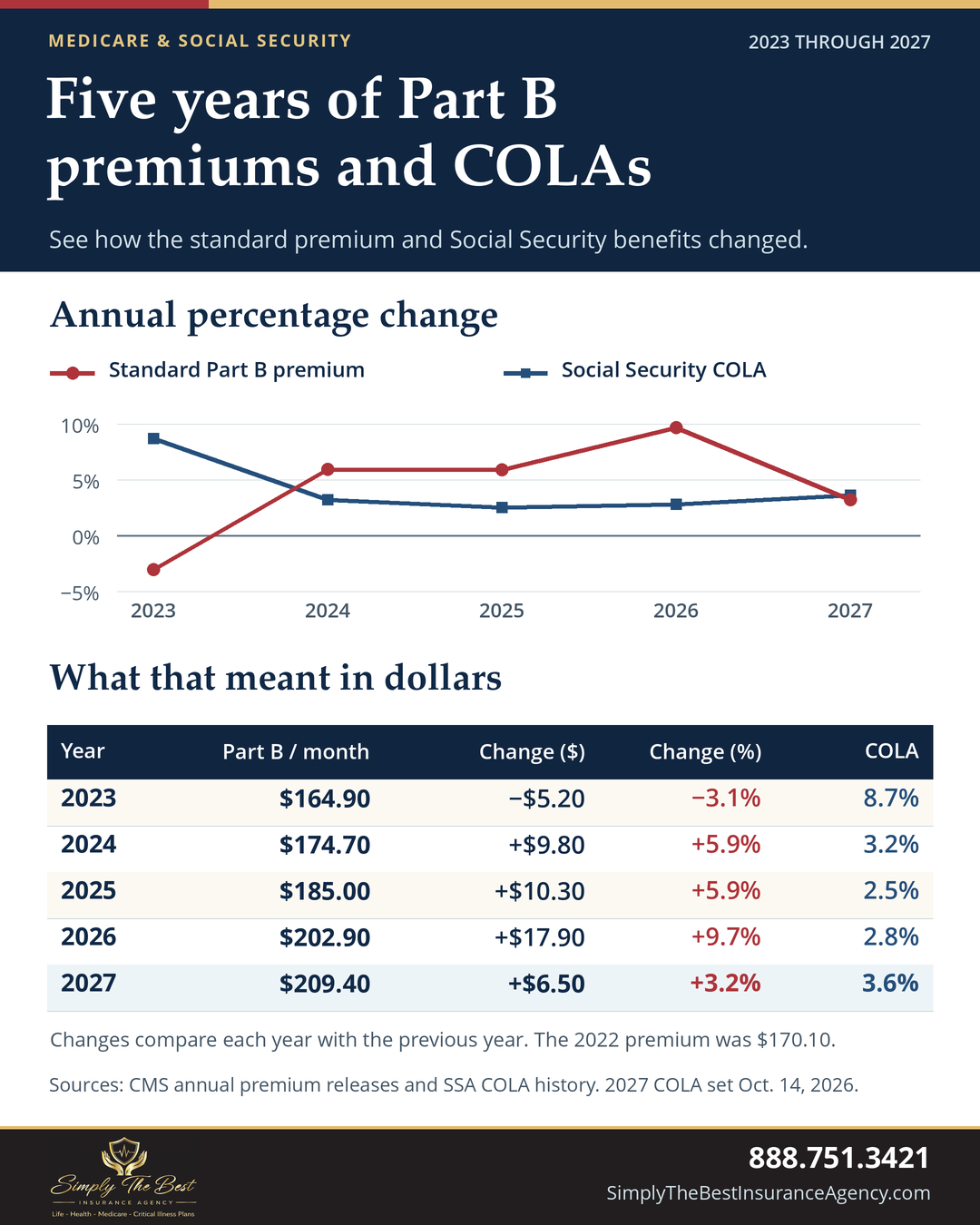
Five years of Part B changes and Social Security COLAs
CMS sets Medicare premiums each year. Social Security calculates the COLA separately using a federal measure of consumer prices. The two can move at different speeds or even in opposite directions. In 2023, the standard Part B premium fell $5.20 while benefits rose 8.7%. In 2026, Part B had its largest dollar increase in this period, $17.90 a month.
| Benefit year | Standard Part B per month | Monthly change | Percent change | Social Security COLA | CMS release date |
|---|---|---|---|---|---|
| 2023 | $164.90 | −$5.20 | −3.1% | 8.7% | September 27, 2022 |
| 2024 | $174.70 | +$9.80 | +5.9% | 3.2% | October 12, 2023 |
| 2025 | $185.00 | +$10.30 | +5.9% | 2.5% | November 8, 2024 |
| 2026 | $202.90 | +$17.90 | +9.7% | 2.8% | November 14, 2025 |
| 2027 | $209.40 | +$6.50 | +3.2% | 3.6% | November 17, 2026 |
Each change compares the new premium with the previous year. The 2022 baseline was $170.10. Percentages are rounded to one decimal. The COLA is labeled by the January payment year.
What does the 2027 change mean for your Social Security check?
Suppose your gross Social Security benefit is $2,000 a month in 2026 and you pay the standard Part B premium through your check. A 3.6% COLA adds $72 to your gross benefit. The Part B increase uses $6.50 of that raise, leaving about $65.50 more per month after Part B. This example assumes your other deductions stay the same. Your actual benefit notice gives your personal amounts.
How the Part B income limits changed
The income limit for paying the standard premium moved from $97,000 for an individual in 2023 to $112,000 in 2027. Each cell shows the upper limit for that band on an individual return, followed by the limit on a joint return.
| Year | Standard rate | First surcharge | Second surcharge | Third surcharge |
|---|---|---|---|---|
| 2023 | $97,000 / $194,000 | $123,000 / $246,000 | $153,000 / $306,000 | $183,000 / $366,000 |
| 2024 | $103,000 / $206,000 | $129,000 / $258,000 | $161,000 / $322,000 | $193,000 / $386,000 |
| 2025 | $106,000 / $212,000 | $133,000 / $266,000 | $167,000 / $334,000 | $200,000 / $400,000 |
| 2026 | $109,000 / $218,000 | $137,000 / $274,000 | $171,000 / $342,000 | $205,000 / $410,000 |
| 2027 | $112,000 / $224,000 | $141,000 / $282,000 | $177,000 / $354,000 | $212,000 / $424,000 |
For each of these five years, the fourth surcharge band ran from just above the third band’s limit to just below $500,000 individual or $750,000 joint. At or above those amounts, the highest surcharge applied. The separate-filer schedule has different thresholds.
The change can lower a real bill even in a year when the standard rate rises. A single filer with $110,000 of MAGI in both relevant tax years would pay $284.10 a month in 2026 and $209.40 in 2027, a decrease of $74.70 a month before any other adjustment.
What changed for people who buy Part A?
About 99% of people with Medicare pay $0 for Part A hospital insurance. Eligibility usually comes from at least 40 quarters, roughly 10 years, of Medicare-covered work on your own or a qualifying spouse’s record. If you buy Part A, 30–39 quarters generally qualify for the reduced premium. Fewer than 30 generally means the full premium. Income does not set these rates.
| Year | Reduced monthly premium | Change from prior year | Full monthly premium | Change from prior year, full rate |
|---|---|---|---|---|
| 2023 | $278 | +$4 / +1.5% | $506 | +$7 / +1.4% |
| 2024 | $278 | $0 / 0.0% | $505 | −$1 / −0.2% |
| 2025 | $285 | +$7 / +2.5% | $518 | +$13 / +2.6% |
| 2026 | $311 | +$26 / +9.1% | $565 | +$47 / +9.1% |
| 2027 | $328 | +$17 / +5.5% | $597 | +$32 / +5.7% |
The 2022 comparison amounts were $274 and $499. The premium-free rate stayed at $0 throughout. The Part A hospital deductible is a separate expense of $1,776 per benefit period in 2027, up $40. The Part B deductible rises $9 to $292 for the calendar year.
How much did higher-income Part B premiums change?
Each cell shows the total monthly premium for that year’s income band, followed by the dollar and percentage change from the previous year’s corresponding band. To find your own change, use the income thresholds and tax return for each year.
| Year | First surcharge band | Second surcharge band | Third surcharge band | Fourth surcharge band | Highest band |
|---|---|---|---|---|---|
| 2023 | $230.80 (−$7.30, −3.1%) | $329.70 (−$10.50, −3.1%) | $428.60 (−$13.70, −3.1%) | $527.50 (−$16.80, −3.1%) | $560.50 (−$17.80, −3.1%) |
| 2024 | $244.60 (+$13.80, +6.0%) | $349.40 (+$19.70, +6.0%) | $454.20 (+$25.60, +6.0%) | $559.00 (+$31.50, +6.0%) | $594.00 (+$33.50, +6.0%) |
| 2025 | $259.00 (+$14.40, +5.9%) | $370.00 (+$20.60, +5.9%) | $480.90 (+$26.70, +5.9%) | $591.90 (+$32.90, +5.9%) | $628.90 (+$34.90, +5.9%) |
| 2026 | $284.10 (+$25.10, +9.7%) | $405.80 (+$35.80, +9.7%) | $527.50 (+$46.60, +9.7%) | $649.20 (+$57.30, +9.7%) | $689.90 (+$61.00, +9.7%) |
| 2027 | $293.10 (+$9.00, +3.2%) | $418.80 (+$13.00, +3.2%) | $544.40 (+$16.90, +3.2%) | $670.00 (+$20.80, +3.2%) | $711.80 (+$21.90, +3.2%) |
Common questions
Which tax return should I check if my premium looks high?
Start with tax year 2025 for 2027 premiums. Check the filing status, adjusted gross income and tax-exempt interest against your Social Security notice. If the IRS has not supplied 2025 data, Social Security may initially use 2024.
I retired after 2025. Can Social Security use my lower income?
Possibly. If stopping or reducing work lowered your income, ask Social Security for a new determination. Form SSA-44 lets you report a qualifying life-changing event and provide supporting documents. If the notice used incorrect information, follow the review instructions on the notice.
Does the income surcharge apply to other parts of Medicare?
Higher income can also add a separate Part D charge if you have prescription drug coverage. The Part B table shows only full Part B coverage. Part A premiums follow work history.
Read your notice with your tax return beside it
Check the tax year and filing status first, then compare the Part B amount with the right row above. Social Security handles decisions about your personal surcharge. For help understanding how Medicare costs fit into your coverage choices, call Laurie and Samson at Simply The Best Insurance Agency.
Sources & further reading
- CMS 2027 Medicare Part A and Part B rates, released November 17, 2026 (opens in a new tab)
- CMS 2026 Medicare Part A and Part B rates, released November 14, 2025 (opens in a new tab)
- CMS 2025 Medicare Part A and Part B rates, released November 8, 2024 (opens in a new tab)
- CMS 2024 Medicare Part A and Part B rates, released October 12, 2023 (opens in a new tab)
- CMS 2023 Medicare Part A and Part B rates, released September 27, 2022 (opens in a new tab)
- CMS 2022 Medicare Part A and Part B rates, released November 12, 2021 (opens in a new tab)
- Social Security’s October 14, 2026 COLA announcement (opens in a new tab)
- Social Security’s historical cost-of-living adjustments (opens in a new tab)
- Federal Register Part B notice, published November 19, 2026 (opens in a new tab)
- Social Security’s definition of modified adjusted gross income and tax-year rules (opens in a new tab)
- Social Security guidance for requesting a lower income-related premium (opens in a new tab)
Sources support general education. This article does not endorse a particular policy or guarantee eligibility.