
Income Down After Retirement? How to Lower or Appeal a Medicare Part B Surcharge
If your Medicare Part B bill includes an income surcharge and you or your spouse retired or cut back at work, you can ask Social Security to use your lower income. Use Form SSA-44 to report the change. If you disagree with a decision on your notice, you can request reconsideration, generally within 60 days of receiving it.
Your last working year can follow you into retirement. Social Security generally uses your federal tax return from two years earlier to set your income-related monthly adjustment amount (IRMAA). That means a 2027 notice can reflect a 2025 salary even if your paychecks have stopped. Look for the tax year, filing status, income and surcharge on the notice.
The income figure to check is your modified adjusted gross income (MAGI). For this Medicare calculation, it is generally your adjusted gross income plus tax-exempt interest. A reduction can help if your income moves into a lower surcharge bracket. The same review can also affect a Part D prescription drug surcharge.
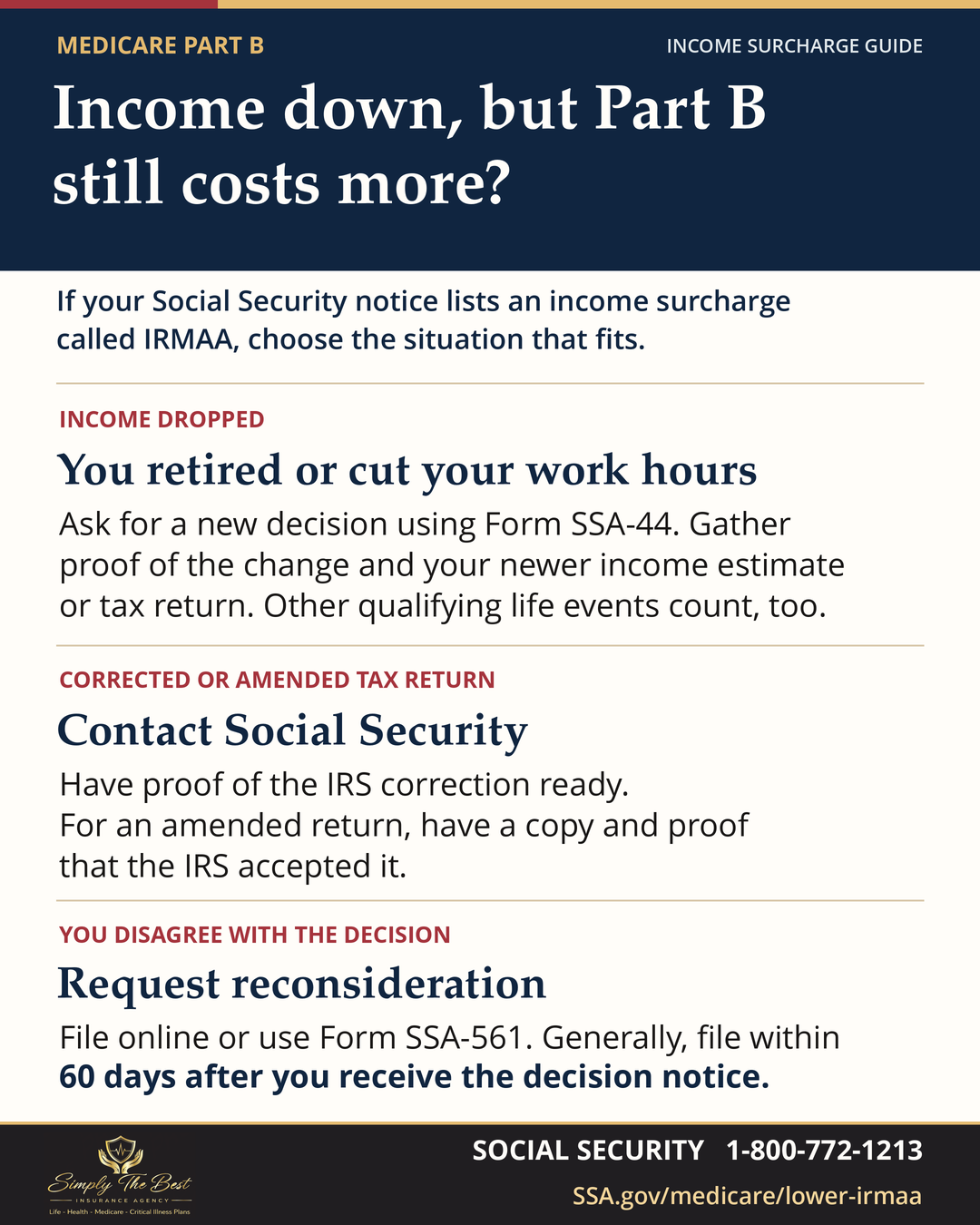
Which route fits your notice?
| What happened | Your next step |
|---|---|
| You or your spouse had a qualifying life change that lowered your income. | Ask Social Security for a new determination using more recent income. You can report the change on Form SSA-44. |
| You amended the return Social Security used, or the IRS supplied an incorrect figure. | Call Social Security at 1-800-772-1213. For an amended return, have your copy and an IRS acknowledgment or transcript. For an IRS error, ask the IRS for a correction and give Social Security the proof. |
| You disagree with Social Security’s decision, including a denial of your request. | Ask for reconsideration. Use the online non-medical appeal or Form SSA-561 and follow the deadline on your notice. |
Which life changes count?
Stopping work and reducing work hours are two common qualifying events. Either can happen to you or your spouse. Social Security also recognizes marriage, divorce or annulment, a spouse’s death, involuntary loss of income-producing property, certain losses of employer pension income, and a settlement from an employer because of bankruptcy or reorganization.
The cause matters. A voluntary property sale or an IRA conversion that raised your income for one year does not, by itself, qualify as a life-changing event. If you also retired, explain when you stopped working and how that affected your income.
How to request a lower surcharge after retirement
- Find your premium notice. Write down the premium year, the income year Social Security used, and the dollar amount shown for IRMAA.
- Gather proof of what changed and when. For retirement or shorter hours, examples include a signed employer statement or copies of pay stubs. For a spouse’s death, Social Security can use an original or certified death certificate. The form lists acceptable evidence for each event.
- Fill in Form SSA-44 with your event date, filing status, adjusted gross income and tax-exempt interest for the more recent year the form asks about. If you have filed that return, provide a signed copy or an IRS transcript. If you have yet to file, use a realistic full-year estimate. Show Social Security a signed copy of the return once you file it.
- Submit through Social Security’s online IRMAA service, or mail or fax the signed form and evidence to your local Social Security office. You can also call 1-800-772-1213 for help. Keep a copy and the submission confirmation.
What could this change in dollars?
Imagine a single retiree whose 2025 MAGI was $125,000. Based on that return, their 2027 Part B premium is $293.10 a month. They stopped working in 2026 and expect $80,000 of MAGI in 2027. If Social Security accepts the newer income and removes the surcharge, their 2027 Part B premium would be $209.40 a month.
That is $83.70 less for each month the lower rate applies, or $1,004.40 over 12 months. This example assumes full Part B coverage and no other premium adjustments. Social Security’s written decision tells you which months it covers.
See all 2027 income brackets and five years of Part B premiums
How to appeal a decision you disagree with
Follow the appeal instructions on the determination notice. You generally have 60 days from the day you receive the notice to request reconsideration. Explain which decision you disagree with, why, and which documents support you. A Social Security reviewer who did not make the original decision will review the request.
You can file online as a non-medical appeal or send Form SSA-561 to Social Security. If the deadline has passed, ask for an extension in writing and explain why you were late. Social Security decides whether there is good cause. Continue to follow your billing notice while waiting for a written decision.
Common questions
If we both pay IRMAA, can one spouse file for both of us?
Each affected spouse should contact Social Security about their own notice, even when you filed one joint tax return and the same retirement changed both premiums. Social Security applies the decision to the person who reported the event.
I already pay the standard Part B premium. Can SSA-44 lower it?
SSA-44 addresses the extra charge for higher income. If you already pay the standard amount and need help paying it, ask your state Medicaid office about Medicare Savings Programs. Depending on eligibility, these programs can pay the Part B premium.
Where should I send my tax return or other evidence?
Submit personal records directly to Social Security using the official online service or its local office instructions. Keep copies for your records. Social Security makes the decision on your surcharge.
Have your notice in front of you when you call
You can say, “My Medicare notice uses income from before I retired. My work stopped on [date]. How do I request a new determination, and what proof do you need?” For general Medicare coverage questions, Laurie and Samson at Simply The Best Insurance Agency can be reached at 888.751.3421.
Call Social Security at 1-800-772-1213
Sources & further reading
- Social Security’s instructions for a lower IRMAA (opens in a new tab)
- Form SSA-44, including evidence and estimated-income instructions (opens in a new tab)
- Social Security’s qualifying-event and spouse reporting rules (opens in a new tab)
- Social Security’s rules for amended or corrected tax information (opens in a new tab)
- Social Security’s Medicare premium lookback and income rules (opens in a new tab)
- Social Security Handbook on the IRMAA appeal deadline (opens in a new tab)
- Social Security reconsideration form and online appeal (opens in a new tab)
- Social Security regulation on filing and extensions for good cause (opens in a new tab)
- CMS’s official 2027 Part A and Part B premiums (opens in a new tab)
- Medicare.gov guide to Medicare Savings Programs (opens in a new tab)
Sources support general education. This article does not endorse a particular policy or guarantee eligibility.